MicroPythonMCU
A Python-programmable microcontroller to drop into an OpenModelica diagram.
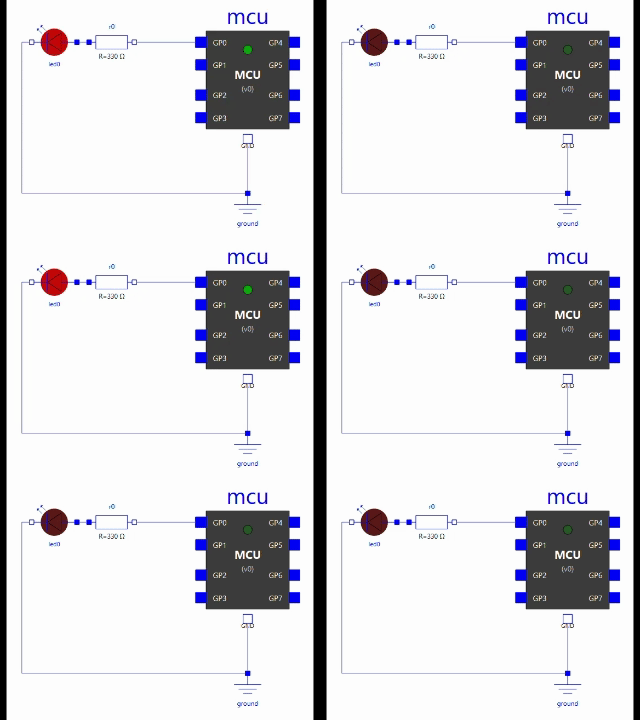
MicroPythonMCU is an OpenModelica library whose MCU block runs a real Python script written against the MicroPython API (machine, time) of the Raspberry Pi Pico. Its pins are real electrical nodes: the script drives and measures the Modelica circuit around it. You can develop embedded code on the digital twin of a system before flashing it onto the real board.
-
User guide
Install the library, simulate a first example, write your own program and wire peripherals. No knowledge of the internals is needed.
-
Maintainer reference (in French)
For those who develop the library: architecture, CPython integration, synchronisation protocol with the solver, serial and I2C engines, verification suite, releases.
What the microcontroller can do
| Feature | Script-side API | Details |
|---|---|---|
| Digital inputs / outputs, interrupts, bit-banging | Pin, Pin.irq() |
API |
| Analog input, PWM output | ADC, PWM |
API |
| Timers, delays | Timer, time.sleep() |
API |
| Electrical serial link | UART |
Serial devices |
| Open-drain I2C master bus | I2C |
I2C devices |
Flash-like file system, boot.py / main.py |
open(), os |
API |
| Module imports, off-the-shelf drivers | import |
The MCU block |
A time.sleep(1) costs no real time: the solver jumps straight to the deadline. One simulated hour runs in a fraction of a second.
Supplied peripherals
LED, teaching display, serial devices (echo, temperature sensor, GPS, 20x2 display, generic device), I2C devices (Grove LCD RGB display, echo, generic device) and a complete weighing chain (load cell, strain-gauge bridge, HX711 converter). The 38 examples use all of them, up to a kitchen scale that runs off-the-shelf MicroPython drivers unmodified.
Current limits
Windows only, no SPI. A model can hold several microcontrollers, which talk through their pins, a serial link or an I2C bus. Full list: Limits and troubleshooting.
Background
Library designed by Benoit Delaup, an engineering science teacher, so that students can test their control code on the digital system before deploying it to a real prototype; it also fits an industrial embedded-software digital twin. Source code and issues: GitLab repository. Architecture choices and their alternatives are recorded (in French) in requirements.md.